Chakra Meditation for Beginners: Seven Cues, One Guided Session
Start chakra meditation with seven simple cues and one guided sequence for all seven energy centers, plus practical ways to build a steady beginner routine.

On this page
Chakra meditation is a body-centred practice that guides your attention through seven energy centres running from the base of your spine to the crown of your head. Begin with a short period of time, such as a few minutes, focusing on one chakra and using your breath as an anchor. This guide gives you a cue for each chakra and a full scripted sequence you can follow straight away.
Key Takeaways
Chakra meditation is most effective when practiced regularly with simple, focused routines that emphasize consistency over duration and incorporate sensory cues for better engagement.
| Point | Details |
|---|---|
| Start small | Begin with short, daily sessions focusing on one chakra to build familiarity and attention skills. |
| Use sensory cues | Pair each chakra with a color, sound, or scent to create reliable triggers that enhance focus. |
| Prioritize consistency | Repeated daily practice makes the routine more effective than occasional long sessions. |
| Focus on the process | Normal mind-wandering is part of the practice; returning focus repeatedly develops mindfulness. |
| Wellinspirit guidance | We recommend using Wellinspirit’s guided rituals and scent pairing to support consistent practice. |
Getting ready: posture, breath and the right environment
You don’t need special equipment to begin. A few minutes of preparation makes the practice easier to sustain.
- Posture: sit on a chair with your feet flat on the floor, or cross-legged on a cushion; lying down works too, provided you can stay alert.
- Breath: breathe gently into your belly rather than your chest, aiming for a slow, even rhythm.
- Environment: choose a quiet spot, dim harsh lighting, and skip heavy caffeine or alcohol beforehand, since both can make settling harder.
- Timing: set a timer for five to ten minutes and attach the session to something you already do, such as waking up or getting into bed.
Guidance on meditation for beginners recommends this short, consistent approach over occasional long sessions, since regularity builds the skill faster than duration does.
Pro Tip: Keep your eyes softly closed or your gaze lowered; this reduces visual distraction without adding effort.
How to focus on each of the seven chakras
Each chakra has a location, a colour, a simple visual cue and a short sound you can repeat silently or aloud. Read these as starting points rather than fixed rules, and keep the language experiential: you’re noticing a feeling, not making a claim about energy.
- Root (Muladhara): located at the base of the spine. Picture a deep red glow and notice the feeling of weight and stability where your body meets the floor or chair. Silently repeat “Lam” and breathe slowly, letting your exhale settle you downward.
- Sacral (Svadhisthana): located just below the navel. Imagine a warm orange light and notice any sense of ease or fluidity in your hips and lower belly. The seed sound here is “Vam”; let your breath soften this area rather than tensing it.
- Solar plexus (Manipura): located above the navel, below the ribs. Visualise a bright yellow light and notice warmth or a sense of steadiness in your midsection. Repeat “Ram” and let each breath expand gently outward from this point.
- Heart (Anahata): located at the centre of the chest. Picture a soft green or pink light and notice any lightness or openness across your chest as you breathe. The sound is “Yam”; some people find it helpful to silently pair it with the word “open”.
- Throat (Vishuddha): located at the base of the throat. Imagine a clear blue light and notice the subtle sensation of your throat relaxing as you breathe. Repeat “Ham” and let your exhale feel unforced, almost like a sigh.
- Third eye (Ajna): located between the eyebrows. Visualise an indigo point of light and notice any stillness or quiet focus in your forehead. The seed sound is “Om” (sometimes written “Aum”); let each repetition slow your thoughts rather than force them away.
- Crown (Sahasrara): located at the top of the head. Picture a violet or white light and notice a sense of openness above you, as if the top of your head were unguarded. Many practitioners use silence here instead of a sound, simply resting attention at that point.
Keep each cue to a line or two so you can read it aloud or recall it from memory while sitting still. Over repeated sessions, the words and colours become shorthand that your mind recognises quickly.
A full guided sequence: all seven chakras in one sitting
This scripted sequence strings the cues above into one practice you can follow without preparation.
- Ground and settle (30 to 60 seconds): close your eyes, take three slow breaths, and feel your weight supported by the chair, cushion or floor.
- Root, 45 to 60 seconds: picture red light at the base of your spine; notice stability; breathe slowly on “Lam”.
- Sacral, 45 to 60 seconds: shift attention to orange light below your navel; notice ease; breathe on “Vam”.
- Solar plexus, 45 to 60 seconds: move to yellow light above your navel; notice warmth; breathe on “Ram”.
- Heart, 45 to 60 seconds: bring attention to green or pink light at your chest; notice openness; breathe on “Yam”.
- Throat, 45 to 60 seconds: picture blue light at your throat; notice relaxation; breathe on “Ham”.
- Third eye, 45 to 60 seconds: focus on indigo light between your brows; notice stillness; breathe on “Om”.
- Crown, 45 to 60 seconds: picture violet or white light above your head; rest in quiet for a few breaths.
- Close and return (30 to 60 seconds): take one more slow breath, let the colours fade, wiggle your fingers and toes, and open your eyes.
For a seven-minute version, spend around 30 seconds per chakra and shorten the opening and closing. For a 35-minute version, extend each chakra to two or three minutes and add a longer closing pause before you move.
Pro Tip: If you lose track of timing, don’t worry about precision; moving through all seven in roughly the same order matters more than exact seconds.
What you might notice during practice, and what to do about it
Your mind will wander, your body may tingle, and feelings can surface unexpectedly. None of this means you’re doing it wrong.
- Mind-wandering is normal; each time you notice it and return to your breath or chakra cue, that return is the practice itself, not a failure of it, according to NHS guidance on meditation.
- Physical sensations such as tingling, warmth or tightness are common; simply name them to yourself and let them pass rather than reacting.
- Emotional shifts can happen too; if something feels overwhelming, open your eyes, plant your feet, and breathe slowly until you feel steady, and speak with a professional if distress persists.
Research on contemplative practice has found differences in brain functional connectivity among regular practitioners, a pattern that may help explain gradual improvements in attention and emotional regulation over time.
Building a lasting daily habit
Consistency matters more than length, especially at the start.
- Begin with short daily sessions and gradually increase the duration as your focus improves, following recommendations from mindfulness programmes such as MBSR exercises.
- Anchor your practice to an existing habit, such as right after waking or just before sleep, and use a timer so you’re not checking the clock.
- If you skip a day, simply restart the next one; a short guided track or a small ritual, like dimming the lights or a warm soak, can help you begin again.
Pro Tip: Pairing your sitting practice with a five-minute micro-session on busy days keeps the habit alive without demanding a full routine.
Guided support when you want audio or ritual structure
If sitting in silence feels difficult at first, guided audio and sensory ritual can bridge the gap. Our members’ library holds guided meditations ranging from five to 35 minutes, so you can match the length to your day, and our chakra-themed ritual boxes pair scent and ritual with your sitting practice. These resources suit you if you struggle to start alone, prefer a voice guiding your pacing, or simply enjoy a sensory cue that signals “practice time” before you sit down.
Where chakra meditation comes from
Chakra meditation draws on a long tradition within yogic and tantric practice in the Indian subcontinent, where the Sanskrit word “chakra” is often translated as “wheel” or “vortex”. Classical texts describe a column of these centres running along the spine, each associated with particular qualities, sounds and symbolic colours. The system was refined over centuries within tantric schools before becoming more widely known outside South Asia during the twentieth century, as yoga and meditation spread through translation, teaching lineages and popular interest in the West.
Modern chakra meditation borrows its structure from this history: the seven-centre model, the seed mantras, and the use of colour and location as focal points all trace back to these older frameworks, even as contemporary teaching often simplifies the symbolism for a general audience. Understanding this background isn’t essential to practising, but it explains why the seven chakras, their Sanskrit names and their associated colours appear so consistently across different teachers and traditions. The practice you follow today sits on top of that inheritance, adapted for a quick daily session rather than years of study.
How chakra meditation differs from general mindfulness
General mindfulness meditation typically asks you to rest attention on the breath, a sound or the body as a whole, returning gently whenever your mind drifts. Chakra meditation borrows that same skill of returning attention, but gives you seven specific, sequential points to visit, each paired with a colour, a location and a short sound. That structure can make the practice easier to follow when you’re newer to meditating, since you always know where your attention is meant to go next.
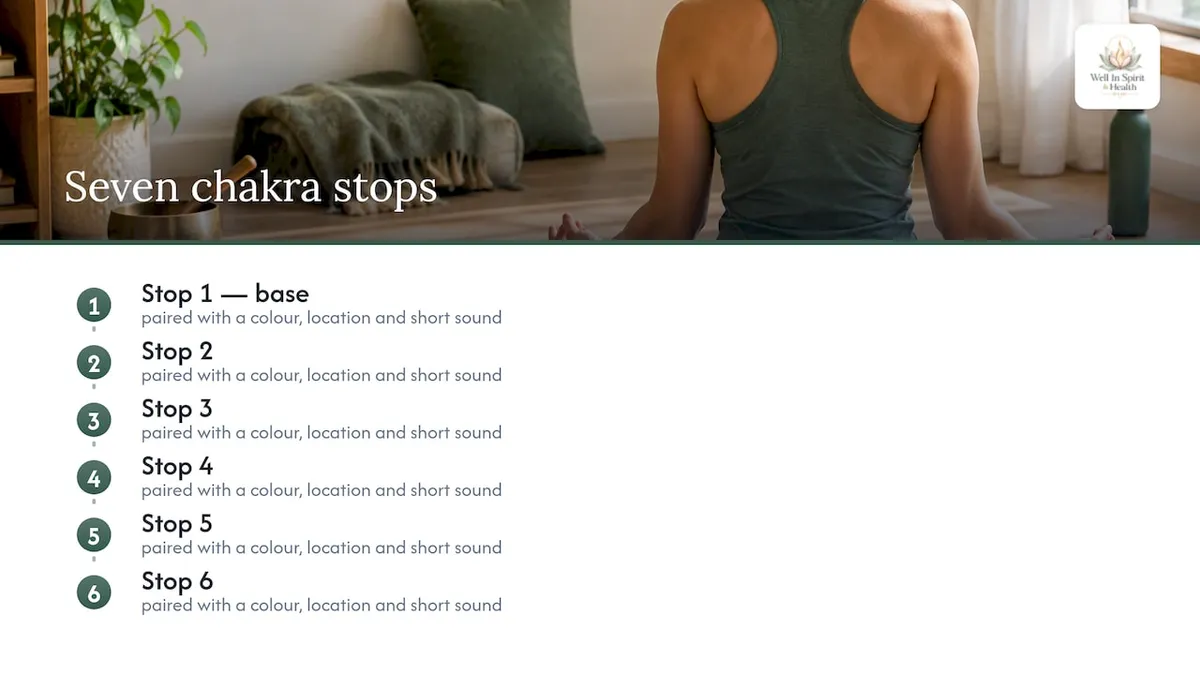
The sequential, body-mapped design also means a short chakra session naturally covers your whole body from base to crown, which a single-point breath meditation doesn’t do in the same way. For some beginners, having seven distinct stops makes a five or ten-minute sit feel less repetitive than holding attention on one spot the entire time. Neither approach is better in every case. General mindfulness and chakra meditation both rely on the same core skill of noticing and returning, and the research on contemplative practice supporting claims about attention and emotional regulation applies broadly across meditation styles rather than to chakra work specifically. Choose chakra meditation when you want structure and variety within a session, and general mindfulness when you want simplicity.
Pairing scent and ritual with your practice
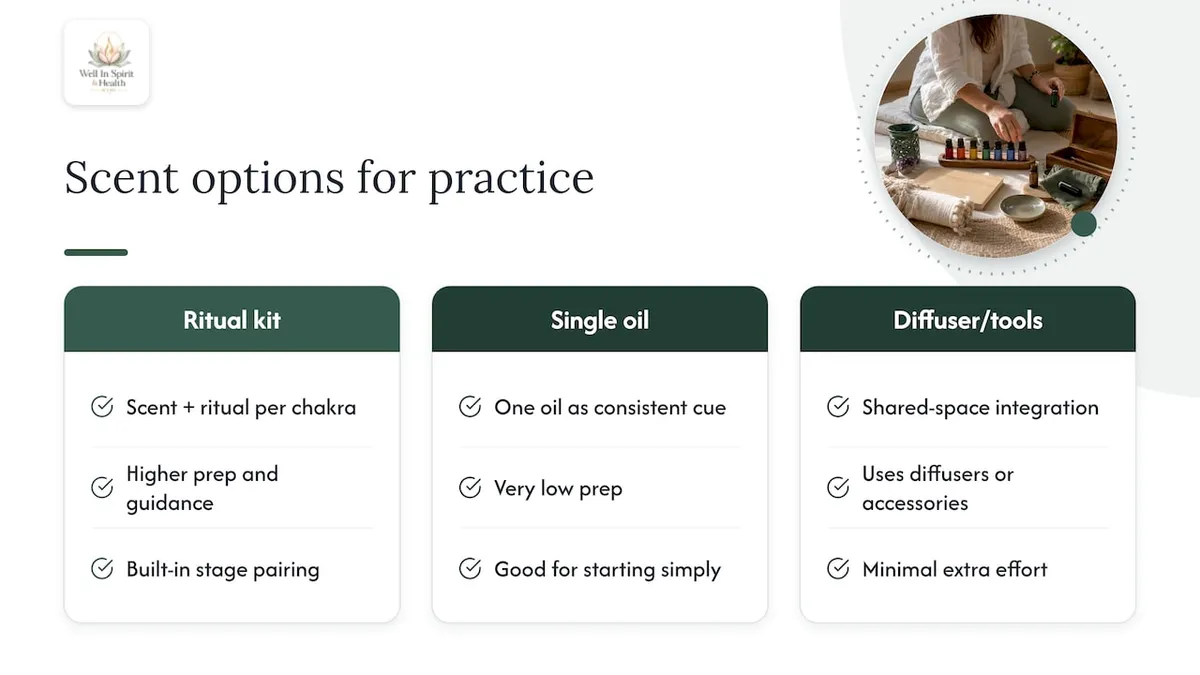
Scent can act as a quick, reliable cue that tells your mind it’s time to settle, and it pairs naturally with chakra work since each centre is often linked to particular moods or qualities. A few drops of a grounding oil before your root chakra cue, or a lighter, brighter scent as you move toward the throat and crown, can reinforce the shift in attention as you progress through the sequence. Our aromatherapy essential oils and ritual boxes, including the Chakra & Third Eye Awakening Ritual, are built around this kind of pairing, giving you a scent and a short ritual to accompany each stage of practice.
You don’t need a full ritual kit to start. A single oil you already associate with calm, used consistently before you sit, can be enough to build the same cue. If you’d rather keep things simple and tool-based, resources such as daily mindfulness tools for shared spaces cover diffusers and other accessories that integrate scent into a routine without much extra effort. Whichever route you choose, the goal is the same: a small, repeatable sensory signal that makes it easier to begin.
Adjusting the practice to suit you
Not every chakra needs equal attention every day. If you tend to feel anxious or scattered, spending longer on the root and solar plexus cues, which centre on stability and steadiness, may serve you better than rushing through all seven. If you find it hard to express yourself or speak up, lingering on the throat chakra cue, noticing your throat relax as you breathe, can be a more useful focus than a brief pass-through.
You can also adjust the format itself: some people prefer to meditate on a single chakra for a full session rather than moving through all seven, especially when short on time or working through a specific feeling. Others find it helpful to journal briefly after each session, noting which chakra felt easiest or hardest to connect with, since this can highlight where to spend more time next. There’s no fixed rule here. The seven-chakra structure is a framework to adapt, not a sequence you must complete identically every time you sit down.
Setting expectations that keep you practising
Chakra meditation won’t feel dramatic on day one, and that’s expected rather than a sign you’re doing something wrong. Early sessions often feel like simply sitting still and trying to remember the next cue, and that’s the practice working as intended.
Progress tends to show up subtly: slightly steadier attention, a quicker return when your mind wanders, or a small sense of calm that lingers a few minutes after you stop. Looking for big shifts in energy or dramatic insight early on tends to set you up for disappointment, while noticing these smaller changes keeps you motivated to continue. Tracking your sessions loosely, even just noting how long you sat and how it felt, can help you see this gradual change over weeks rather than expecting it after a handful of sittings.
What actually matters when you’re starting out
The beginner advice around chakra meditation often overcomplicates things with elaborate symbolism, long lists of associated crystals, and claims that stretch well beyond what any of us can verify. What actually helps a new practitioner is much simpler: a short, repeatable sequence, a consistent time of day, and permission to return to the cue whenever attention drifts, which it will.
I’d argue the single biggest mistake beginners make is treating the seven-chakra sequence as something to perfect rather than something to repeat. A messy five-minute sit done daily for a month will do more for your attention and calm than one carefully planned 40-minute session done once. Prioritise showing up over getting the visualisation exactly right, and let the colours, sounds and locations become familiar through repetition rather than study. The ritual and sensory elements, scent, lighting, a short audio track, are genuinely useful, but only as support for consistency, never as a substitute for actually sitting down.
— Rob
Bring guided ease to your practice
Our Chakra & Third Eye Awakening Ritual pairs scent and guided structure to support your sessions from the first sit onward.

FAQ
How do I start chakra meditation as a complete beginner?
Sit comfortably, breathe slowly, and bring your attention to one chakra at a time, starting at the root and moving upward. Begin with five to ten minutes, as recommended in NHS guidance on meditation, and build up gradually once the routine feels familiar.
What’s a good first practice for the root chakra?
Sit or lie down, breathe into your belly, and picture a deep red light at the base of your spine while silently repeating “Lam”. Spend 45 to 60 seconds simply noticing any feeling of stability or weight where your body meets the ground.
What are the seed mantras for the seven chakras?
The commonly used seed sounds are “Lam” for the root, “Vam” for the sacral, “Ram” for the solar plexus, “Yam” for the heart, “Ham” for the throat, “Om” for the third eye, and silence for the crown. These are repeated silently or softly aloud while holding attention on each chakra’s location.
How do I activate my chakras as a beginner?
Rather than thinking in terms of “activating” anything, focus on noticing: bring your attention to each location, picture its colour, and breathe slowly while repeating its seed sound. Doing this consistently, even briefly, is the practice; mind-wandering is normal, and returning your focus each time is what builds the skill.
How long should a beginner meditate on chakras each day?
Start with five to ten minutes a day and let the session grow toward 20 to 25 minutes as your attention steadies, following the pacing suggested in NHS guidance. Consistency matters more than length, so a short daily sit beats an occasional long one.
Sources
- How to meditate for beginners (NHS)
- Meditation and brain functional connectivity (PMC)
- MBSR exercises (Guy’s and St Thomas’)


